Philippines Top 10 Fairytale Places introduces a world of enchanted landscapes, ancient villages, and mystical waters that remain untouched by mainstream tourism.
By discovering Philippines Top 10 Fairytale Places, travelers immerse themselves in storybook scenery where mist-shrouded mountains meet underground rivers, volcanic wonders stand as nature’s temples, and traditions spanning millennia continue in hidden valleys.

1. Batad Rice Terraces in Ifugao
Carved into mountainsides over two thousand years ago, the Batad Rice Terraces form an amphitheater of emerald steps that rise dramatically from a central village nestled at their base.
Accessible only by foot through mountain trails, this UNESCO World Heritage site offers a solitude few modern destinations provide. The legendary Ifugao people engineered these terraces using primitive tools and deep knowledge of hydrology, creating an intricate irrigation system fed by forest water sources.
The undulating landscape transforms throughout the year, with rice crops shifting in color and height while mist wraps around peaks at dawn. Traditional wooden homes with earth-toned walls blend seamlessly with the surrounding agriculture.
At dawn and dusk, atmospheric conditions create an otherworldly beauty where layers of mist rise from the valleys, transforming the visible terraces into something approaching a fairytale vision of a lost civilization.
2. Camiguin Island and its volcanic wonders
Shaped by intense volcanic activity over centuries, Camiguin Island contains seven volcanoes within its compact geography, earning its evocative moniker. The island creates dramatic contrasts in its landscape – black volcanic sand beaches adjoin white sandbars, while hot springs flow into cool mountain streams.
White Island, a gleaming sandbar emerging from impossibly clear waters, appears and disappears with tidal cycles like a mirage born from tropical dreams.
The Sunken Cemetery marks where an entire graveyard sank following volcanic upheaval, with a stone cross visible above waterline as a monument to nature’s power.
Mantigue Island reveals vibrant coral gardens teeming with marine life, while the surrounding waters maintain crystalline clarity that makes snorkeling feel like floating through liquid glass.
The landscape consistently evokes the feeling of standing on an island born yesterday from the earth itself.
3. Sohoton Natural Bridge National Park in Samar
Within the lesser-visited island of Samar lies an expansive protected area where limestone formations create a landscape of geological grandeur.
The Sohoton River winds through dense jungle, flanked by towering cliffs and countless cave systems. Kayaking beneath the natural stone bridge that gives the park its name creates moments of profound awe, as paddlers glide into cathedral-like chambers where limestone walls rise majestically on both sides.
The Panhulugan Cave contains formations that resemble mountains, chocolate hills, and other famous landmarks, shaped by water flowing through stone over millennia. Golden-hued water reflects surrounding foliage, creating shifting patterns of light and shadow throughout the day.
The park spans over eight hundred hectares, with lush jungle pressing close to the river while bats roost in cave ceilings and birds call from the canopy. Few tourists venture to this sanctuary, making encounters with nature feel intimate and revelation-like.
4. Siquijor Island – the Mystic Island
Steeped in centuries of folklore regarding shamanic healing and folk magic traditions, Siquijor maintains an otherworldly reputation that precedes its actual charms.
Spanish explorers initially named it the Island of Fire, believing they witnessed flames – which were actually fireflies swarming over ancient molave trees at night. The island’s interior conceals numerous waterfalls, including Cambugahay Falls, which cascades into a natural infinity pool surrounded by dense jungle canopy.
The 400-year-old Enchanted Balete Tree stands as a landmark of spiritual significance, its gnarled trunk marked with centuries of age. Turquoise waters lap against white sand beaches, while local folk healers continue traditions that blend Catholicism with ancestral shamanic wisdom, giving the island a mystique that tourism cannot fully capture.
The convergence of spiritual practice and natural beauty creates an atmosphere unlike any other destination in the Philippines.
5. Hinatuan enchanted river in Surigao Del Sur
Emerging from unseen sources beneath the earth, this river displays a luminous blue-green hue that defies ordinary explanation.
The water arrives pristine and clear, free of the sediment that typically clouds river systems, suggesting it passes through an underground cave system that filters and purifies its flow.
Surrounded by dense rainforest and towering limestone cliffs that seem to press close to the water’s edge, the river occupies a space that feels removed from ordinary reality. Local legends speak of fairies, mermaids, and mystical beings dwelling in its mysterious depths, stories passed down through generations of indigenous peoples.
The jungle vegetation hangs low, with vines and orchids completing the picture of untouched wilderness where few sounds penetrate except water flowing and birds calling overhead. Cave systems connected to the river remain only partially explored, maintaining the river’s mystique and sense of hidden wonders waiting to be discovered.
6. Chocolate hills in Bohol
Over one thousand perfectly cone-shaped hills rise from Bohol’s landscape, creating a geological formation unique among Earth’s natural wonders.
During the dry season, the grass covering these hills dries to chocolate brown, fulfilling the promise of their whimsical name and creating photographic moments of surreal beauty. These formations, created through ancient limestone uplift and subsequent erosion over millions of years, vary in height from modest rounded mounds to peaks reaching 120 meters skyward.
Viewing decks positioned at strategic vantage points reveal the breathtaking scope of this natural amphitheater, where the eye stretches across waves of identical mounds extending toward distant horizons.
Local legends attribute their creation to a giant’s tears shed in grief or to debris from mythological battles between colossal beings. The undulating terrain, when viewed from above, suggests a landscape designed by imagination rather than geological processes alone.
7. Sagada, home of the hanging coffins
In this remote mountain village, burial traditions spanning over two thousand years continue in defiance of modern conventions and sensibilities.
Wooden coffins hang suspended on limestone cliff faces, positioned so the deceased rest elevated toward ancestral spirits and the heavens. The ancient Igorot people developed this practice believing that elevation brought departed souls closer to the spiritual realm. Echo Valley reveals these extraordinary grave sites perched precariously on stone faces, visible from certain vantage points and accessible through networks of underground cave systems.
The village itself maintains a quiet, introspective character, with stone-built homes and winding paths that seem untouched by decades of external influence.
Mist often blankets the valley, lending an ethereal quality to the landscape and deepening the sensation of standing in a place apart from contemporary time.
Walking through Echo Valley creates a profound contemplative mood where mortality feels tangible and history seems present.
8. Lake Sebu and the T’boli dream weavers
In the highlands of South Cotabato, this lake community showcases a living artistic tradition where textile designs originate solely from the dreams of weavers.
The T’boli people maintain a spiritual belief that the Goddess of abaca fiber, Fu Dalu, visits weavers during sleep, revealing sacred patterns that cannot be replicated or mass-produced. Each cloth represents a unique vision given by deity to artist, making the textiles sacred objects rather than commercial commodities.
The lake itself remains serene, surrounded by seven waterfalls that cascade from encircling cliffs into pristine waters. Ziplines stretch across waterfalls, allowing adventurers to soar through space while surrounded by undisturbed jungle canopy.
Homestays nestled along the water’s edge offer sunrise ceremonies honoring both the lake and the spiritual traditions of its indigenous inhabitants. The combination of natural wonders and cultural authenticity creates a destination where tourism supports rather than disrupts traditional ways of living.
9. Vigan, the Spanish colonial time capsule
Established in the sixteenth century and meticulously preserved through careful stewardship, Vigan represents Southeast Asia’s finest surviving example of planned Spanish colonial urban development.
Calle Crisologo, its most iconic street, maintains original cobblestone pavements and ancestral houses featuring wooden facades adorned with intricate carvings dating to colonial centuries. Horse-drawn carriages navigate these streets, their rhythmic hoofbeats echoing off stone buildings that witnessed countless generations of history and trade.
The Vigan Cathedral, constructed with earthquake-resistant baroque architectural principles adapted to local seismic conditions, stands as testament to Spanish innovation. The city functions as a living museum where residents inhabit centuries-old structures, shops sell traditional wares, and the air itself carries stories of maritime trade routes and colonial ambition.
Walking these streets transports visitors to a moment centuries past, allowing them to experience what numerous towns throughout the colonial world must have resembled before modernization erased their character.
10. Mayon Volcano in Albay
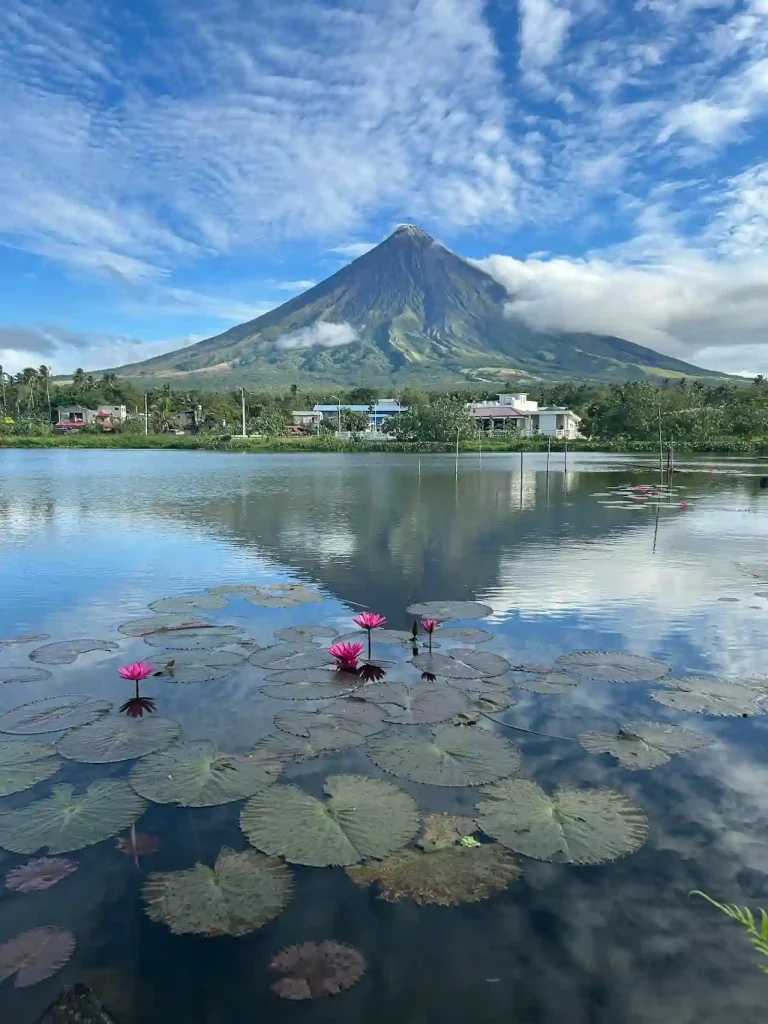
The world’s most perfectly symmetrical cone-shaped volcano dominates the Bicol landscape with an almost supernatural geometric precision.
Rising 2,462 meters in an unbroken curve that remains visible from virtually any vantage point circling the base, Mayon embodies geological perfection. Its slopes glow with vibrant emerald vegetation during the wet season, then transition to golden-brown hues as the dry season progresses, creating seasonal transformations visible across distances.
Local legend attributes the volcano’s creation to a love story between a maiden named Magayon and a supernatural being, with the mountain representing eternal beauty and latent power.
Surrounding towns depend on Mayon’s fertile volcanic soil for their agricultural prosperity, making the mountain simultaneously provider and potential destroyer.
The Cagsawa Ruins, remnants of a sixteenth-century church buried during a catastrophic volcanic eruption, stand as haunting reminders of the volcano’s awesome force while simultaneously celebrating human resilience and spiritual faith.