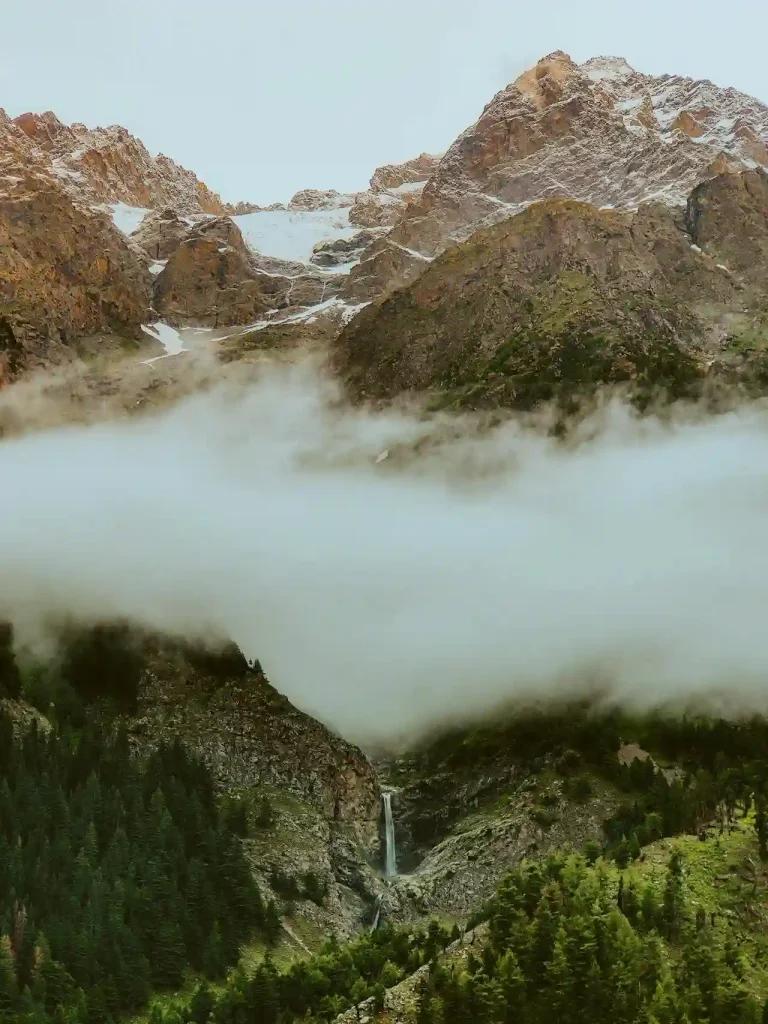
Pakistan Top 10 Fairytale Places introduces travelers to landscapes where ancient mountains cradle emerald valleys, and crystalline lakes mirror snow-capped peaks, transforming the northern region into a realm of storybook wonder.
By exploring Pakistan Top 10 Fairytale Places, visitors uncover destinations where misty mornings rise above hidden villages, where traditional cultures thrive untouched by mass tourism, and where every valley presents a new layer of beauty waiting to be discovered in this underrated travel destination.

Swat Valley and the enchantment of Kalam
Swat Valley stands as one of Pakistan’s most fairytale-like regions, earning its nickname as the “Switzerland of the East” through dramatic green slopes, fast-flowing crystal-clear rivers, and towering peaks that pierce the clouds.
The town of Kalam serves as the gateway to discovering this mountain paradise, though the real magic lies in the lesser-known villages and meadows surrounding it.
Matiltan rises as an alpine wonderland just a short distance away, where dense forests frame pristine landscapes and shepherd communities maintain ancient pastoral traditions.
Utror Valley adds another layer to Swat’s hidden charm, with its kundol lake reflecting surrounding mountains and seasonal transformations from lush summer greenery to dreamlike winter whiteness.
Hidden gems like Desan Meadows sit at 11,000 feet elevation, offering panoramic vistas across endless forested ridges and shepherd pastures.
The region maintains an off-the-beaten-path quality despite its accessibility, with visitors often finding themselves wandering through forests where the air carries the scent of cedar and the sound of mountain streams provides constant musical accompaniment.
Fairy Meadows at the base of Nanga Parbat
Fairy Meadows represents one of Pakistan’s most magical fairytale destinations, occupying a location where three of the world’s greatest mountain ranges converge – the Hindu Kush, Karakoram, and Himalayas.
Situated at approximately 3,300 meters altitude at the base of Nanga Parbat, the world’s ninth-highest mountain, these elevated meadows deliver an otherworldly landscape that defies easy description.
The journey itself becomes part of the adventure, beginning with an exhilarating jeep ride across dangerous mountain terrain before transitioning to a two-hour trek through alpine environments.
The final destination reveals a landscape where emerald meadows stretch across the mountainside, framed by towering granite walls and crowned with permanent snow. Visitors sleep beneath star-filled skies in mountain camps, where the silence of the wilderness becomes profound.
The meadows hold a legendary quality rooted in local mythology and mountaineering history, serving as both a spiritual sanctuary and launching point for those attempting to summit the technical ice slopes above. Photography here transcends documentation – it captures the essence of a hidden paradise.
Hunza Valley and the Baltit Fort
Hunza Valley radiates an almost mythical quality that has captivated travelers for centuries, and the valley’s ancient capital, Karimabad, stands as its fairytale crown jewel.
Perched dramatically on a green hillside overlooking the entire valley, Karimabad combines stone pathways winding through traditional villages with commanding views of surrounding peaks including Ulter Peak and the iconic Lady Finger formation.
The town’s centerpiece, Baltit Fort, rises with fairy-tale architecture built in the eighth century BC on a natural moraine, its wooden bay windows and fortress silhouette creating a scene that belongs in storybooks. Local legends swirl through Karimabad’s narrow lanes, where former royal family members still reside and shopkeepers maintain traditions stretching back generations.
The surrounding valleys – including the lush Hoper Valley and endless orchards of apricot and cherry trees – create a landscape of agricultural bounty against a backdrop of permanent snow. The region’s inhabitants maintain distinctive customs and a unique identity that feels preserved from an earlier era.
Kaghan Valley’s alpine lakes and Sharan Forest
Kaghan Valley remains one of Pakistan’s most underrated travel destinations for those seeking whimsical, fairytale-like experiences away from tourist crowds. The valley’s hidden gems extend far beyond the famous Saif-ul-Maluk Lake, with lesser-known alpine waters offering deeper immersion into untouched wilderness.
Dudipatsar Lake sits at 3,800 meters elevation, its turquoise water reflecting surrounding snow peaks and creating mirror-like reflections that transform the landscape into dreamlike imagery. The trek passes through wildflower meadows and alongside streams fed by glacial melt, where shepherds guide livestock to summer pastures.
Sharan Forest, accessible only by four-wheel-drive from the village of Paras, presents an enchanted woodland where dense green canopies shelter visitors from the outside world. This forest environment maintains a quality of sacred wilderness, where the only sounds are birdsong and wind rustling through ancient cedar groves.
Wooden glamping structures blend seamlessly with the forest environment, allowing visitors to experience mountain wilderness without sacrificing comfort. The entire valley system offers a network of hidden locations where most travelers never venture.
Ratti Gali Lake in Neelum Valley
Ratti Gali Lake stands as one of Asia’s most enchanting alpine lakes, crowning a location in Neelum Valley where mountains meet clouds and wildflower meadows create natural carpets of color.
Situated at 12,130 feet above sea level, this glacial lake presents waters of such crystalline clarity that they reflect the surrounding environment like polished glass, creating the sensation of floating in air between earth and sky.
The approach journey involves a thrilling jeep ride through mountain passes followed by a trek through landscape where every step reveals new natural wonders. Streams flow like silver ribbons through valleys, and clusters of alpine meadows sparkle with moisture and wildflower blooms.
The lake’s remoteness ensures its preservation as a pristine natural environment where tourism remains minimal and the landscape unchanged by development. Local shepherds inhabit higher elevations, their flocks adding to the living pastoral atmosphere.
The night sky above Ratti Gali offers stargazing experiences unmatched in populated regions, with the Milky Way stretching in impossible clarity across the darkness above.
Attabad Lake’s turquoise waters
Attabad Lake presents a unique fairytale born from natural disaster, its stunning turquoise waters now drawing travelers to witness extraordinary beauty emerging from catastrophe.
Formed in January 2010 when a massive landslide dammed the Hunza River, this 21-kilometer-long lake reaches depths exceeding 100 meters and showcases water colors ranging from brilliant turquoise to deep cobalt depending on light conditions and season. The distinctive color originates from glacial minerals suspended in the water, creating an otherworldly visual experience that appears almost artificially enhanced.
The lake sits at over 8,000 feet elevation, framed by towering mountains that create natural amphitheater walls rising vertically from the water’s edge. Boating excursions allow visitors to navigate the tranquil waters while observing dramatic mountain formations and accessing remote villages accessible only by water routes before tunnel construction.
The contrasts between this serene alpine water environment and the violent geological forces that created it add philosophical depth to the visitor experience. Sunset views transform the landscape into shades of gold and crimson reflected in perfect mirror surfaces.
Kalash Valleys and ancient cultural traditions
The Kalash Valleys of Chitral represent a living museum of ancient traditions and whimsical cultural practices that have survived for centuries in mountain isolation.
Three interconnected valleys – Bumburet, Rumbur, and Birir – maintain indigenous Kalash communities whose customs, festivals, and architectural traditions remain virtually unchanged from centuries past. Traditional dwellings constructed from wood and stone without modern paint possess a rustic allure, with interiors warmed by wood fires and aromatic cooking practices.
The Kalash people celebrate festivals with vibrant clothing, traditional music, and ancient rituals that transform the valleys into fairytale settings of color and cultural expression. Stone pathways wind through villages where livestock graze in nearby meadows and traditional crafts continue uninterrupted by modernity.
The surrounding mountain environment creates a natural sanctuary where these communities have maintained their identity despite pressure from the outside world. Visitors encounter genuine hospitality and authentic cultural exchange impossible to find in mainstream tourism destinations.
Shandur Pass and the world’s highest polo festival
Shandur Pass holds the distinction of hosting the world’s highest polo ground at 3,700 meters elevation, a natural plateau transformed each July into a stage for one of Earth’s most extraordinary sporting and cultural events.
The annual Shandur Polo Festival brings together teams from Chitral and Gilgit-Baltistan to compete on grass fields surrounded by snow-capped Hindu Kush peaks, creating a spectacle where ancient traditions meet athletic passion.
The polo itself employs handcrafted wooden mallets and locally manufactured balls rather than modern equipment, and horses specifically bred and trained for high-altitude performance navigate the challenging terrain with remarkable agility. Beyond the sporting competition, the festival celebrates local music, folk dancing, traditional parades, and the hospitality of mountain communities.
The natural landscape around the polo ground displays raw beauty unmatched in most tourist destinations, with cloud-covered meadows and distant peaks creating an almost mythical atmosphere. The thousands of spectators gather under open skies on this remote mountain pass, transforming it temporarily into a gathering place where international visitors witness traditions extending back centuries.
Deosai National Park and the plains of dreams
Deosai National Park claims status as the world’s second-highest large plateau, occupying 3,000 square kilometers of largely uninhabited grassland at 4,114 meters elevation, surrounded by peaks exceeding 20,000 feet.
Locally known as “Ghbiarsa” or “Summer’s Place,” these vast alpine plains present rolling meadows carpeted with wildflowers that create natural flower gardens visible from great distances. Sheosar Lake, translated as “blind lake” because water exits remain hidden, occupies a central location within the park, its deep blue waters reflecting majestic mountain backdrops that complete scenes of unparalleled wilderness beauty.
The plains support diverse wildlife including brown bears that hunt fish in winding streams, marmots living in high-altitude colonies, and golden eagles soaring across cloud-touched horizons. The stark landscape offers profound solitude and connection with untouched nature, with visitors experiencing the unique sensation of existing in a wilderness so vast and empty it approaches the otherworldly.
Camping beneath clear night skies reveals star fields impossible to witness in developed regions, offering stargazing experiences that fundamentally shift perspective on human scale within the cosmos.
Yasin Valley and Misgar Valley in Hindu Kush
Yasin Valley and Misgar Valley represent Pakistan’s most underrated travel destinations, existing in a realm of fairytale-like beauty that remains virtually untouched by mass tourism despite proximity to the Karakoram Highway.
Yasin, nestled deep within the Hindu Kush, offers enchanting landscapes packed with awesome trekking opportunities and hidden gems consisting of rivers and mountains creating natural barriers to tourism development. The valley’s relatively small population and minimal infrastructure ensure an authentic experience of mountain life unchanged by commercial tourism pressures.
Misgar Valley’s history as one of five Silk Road routes passing through the region infuses the landscape with historical mystique, where ancient trading traditions echo across mountain passes and through remote settlements.
These valleys present extraordinary natural beauty – dramatic gorges, rushing rivers, alpine meadows – combined with the special quality of discovery that comes from exploring destinations where foreign tourists remain uncommon.
The local communities maintain their original character and traditions, welcoming visitors with genuine warmth rather than commercial interest.