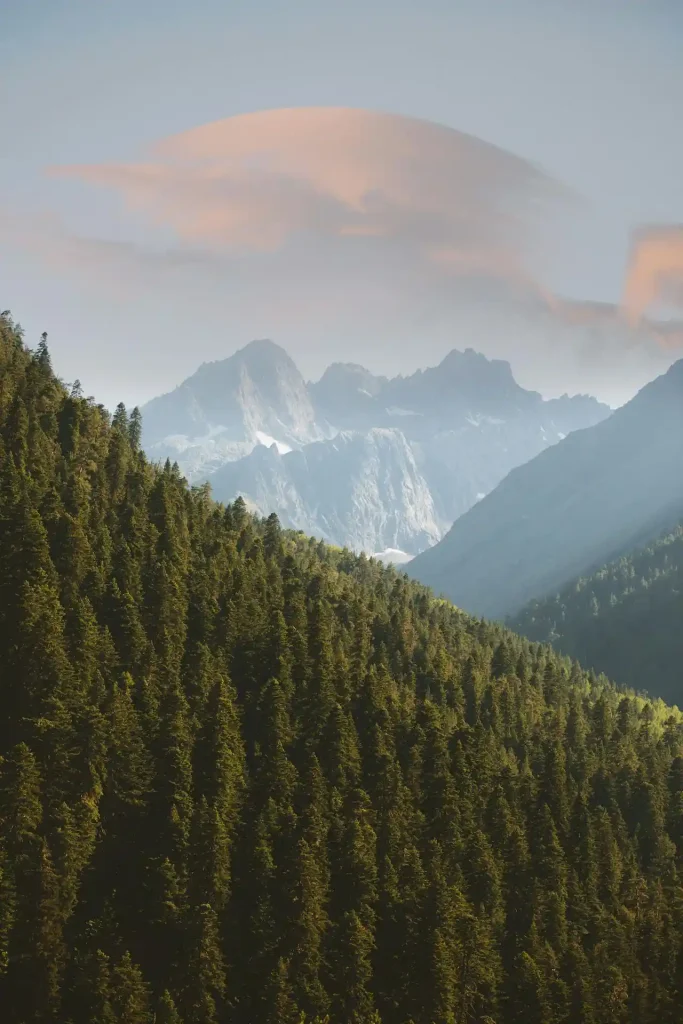
Russia Top 10 Fairytale Places introduces travelers to a world where crystalline lakes mirror ancient mountains, hidden monasteries rest on remote islands, and underground chambers glow with ethereal light.
Our selection of Russia Top 10 Fairytale Places reveals the most enchanting and lesser-known corners of this vast country: destinations where nature and history converge to create landscapes few have witnessed.

1. Lake Baikal – The deepest mirror of Siberia
Lake Baikal stands as one of the world’s most remarkable natural wonders, holding nearly one-quarter of Earth’s fresh surface water. This ancient freshwater lake, located in southern Siberia, reaches depths of 1,642 meters, making it not only the deepest but also the oldest freshwater lake on the planet.
The surrounding landscape reveals taiga forests of towering firs and pines, with rocky shores that rise dramatically from the water. In winter, the lake’s surface transforms into an extraordinary spectacle – transparent blue ice so clear that the lakebed becomes visible from above, occasionally sparking an almost surreal optical illusion.
The village of Listvyanka, perched on the southwestern shore, serves as the gateway to this natural cathedral.
Local seals, found nowhere else in the world, glide through the crystalline waters, while mountain passes offer vistas across seemingly endless wilderness. The hidden beaches and mineral-rich thermal springs scattered along the northern stretches remain largely untouched by mass tourism.
2. Putorana Plateau – Mountains without peaks
Rising across the Krasnoyarsk Territory of northern Siberia, the Putorana Plateau encompasses an otherworldly landscape of basaltic cliffs, interconnected lakes, and rushing waterfalls that plunge into mist-filled gorges.
The name itself translates to “lakes with steep banks” or “mountains without peaks” – a poetic description of this volcanic formation.
The plateau harbors the Talnikovy Waterfall, which plummets 600 meters and ranks among the highest waterfalls in Eurasia. Due to its remote location and continental climate, the waterfall only flows during spring snowmelt, revealing itself for a fleeting few weeks before the landscape transforms once again. More than 250 waterfalls cascade across the region, while dense boreal forests conceal reindeer, wolverines, and bears in their depths.
The geographical center of Russia passes through Lake Vivi on the plateau, a designation befitting this central point of untouched grandeur. Few travelers venture to this frontier, leaving its mystic valleys and hidden caverns largely undiscovered.
3. Ruskeala marble quarry – The underground kingdom
Tucked within the forests of Karelia, the Ruskeala Mountain Park occupies an abandoned marble quarry that local artisans transformed into a subterranean wonderland.
Beginning in the 17th century, workers extracted marble of exceptional quality – creamy white and soft pastels – that would eventually adorn palaces and churches across St. Petersburg. The mining process carved monumental chambers deep within the mountain, creating halls with vaulted ceilings and endless corridors.
Today, the quarry sits partially flooded with crystal-clear water, reflecting the marble walls in luminous blues and greens. Visitors descend through atmospheric underground passages where careful lighting casts shadows on ancient stone, evoking a sense of stepping into another era. The main quarry measures 456 meters in length and reaches 50 meters in depth, its scale overwhelming against the human frame.
The “Kingdom of the Snow Queen” – a glacial sinkhole – and the “Italian Quarry” remain lesser-explored corners of this subterranean landscape, preserving the quiet mystery of industrial heritage merged with natural beauty.
4. Kizhi Pogost – Timber and domes
On an island in the middle of Lake Onega stands Kizhi Pogost, an architectural ensemble so improbable that it seems conjured from folklore rather than historical reality.
The centerpiece, the Church of the Transfiguration, rises 37 meters skyward with 22 onion-shaped domes that catch light like burnished silver. What renders this structure even more miraculous is that not a single nail was used in its construction – master carpenters employed an ancient system of interlocking logs, creating a structure of such geometric precision that it has survived four centuries.
The adjoining Church of the Intercession, completed a generation later, echoes the same timber artistry with nine domes of its own. A wooden bell tower from the 19th century completes the enclosure, all three structures unified by their harmony with the northern landscape.
The surrounding open-air museum preserves traditional wooden houses, mills, and saunas that reveal how inhabitants of these remote islands lived in harmony with forest and water.
The site receives relatively few international visitors compared to Russia’s metropolitan attractions, making it a genuine hidden gem of wooden architecture.
5. Solovetsky Islands – Monastery of the extreme north
Six major islands and hundreds of smaller ones form the Solovetsky Archipelago, emerging from the White Sea near the Arctic Circle.
Founded in 1436 by monks seeking spiritual isolation, the Solovetsky Monastery became a beacon of Orthodox faith and a center of learning and craft in Russia’s far north. Surrounding the monastery complex are fortress walls constructed from enormous boulders, forming a fortress-like enclosure that protected inhabitants during centuries of Swedish raids and religious turmoil.
The islands harbor over 60 interconnected lakes, linked by channels built by monks during the 16th and 20th centuries – an engineering feat of quiet ambition. The botanical garden, established in the 19th century, displays unexpected plant varieties thriving in the subarctic environment. The Stone of Negotiations, placed on the southwestern coast, commemorates the monastery’s successful defense against British warships during the Crimean War.
The remote location – requiring boat access across often turbulent waters – and its layered history as monastery, prison camp, and naval base lend the islands a palpable sense of having witnessed profound human experiences. The midnight sun of summer and the profound darkness of winter create temporal extremes that heighten the islands’ ethereal quality.
6. Veliky Novgorod – Chronicle of ancient Rus
Situated on the banks of the Volkhov River just below Lake Ilmen, Veliky Novgorod stands as one of Russia’s oldest and most historically consequential cities.
Founded in 859 and first mentioned in chronicles centuries before Moscow or St. Petersburg, this medieval center witnessed the crystallization of Russian civilization.
The Kremlin, known as the Detinets, rises on the left bank of the river with walls measuring 1,487 meters in perimeter and towers still standing after more than five centuries.
Within these ramparts sits the Cathedral of St. Sophia, the oldest Orthodox cathedral in Russia, its golden dome reflecting across the river in scenes that have remained largely unchanged since the 11th century. Medieval chronicles were copied and preserved here; state and religious business transpired within these walls.
The Yaroslav’s Court on the opposite riverbank reveals the trading foundations of Novgorod’s medieval prosperity. Despite its historical significance, Veliky Novgorod remains far less visited than Russia’s more famous destinations, allowing visitors to experience authentic medieval atmosphere without overwhelming crowds. The combination of genuine antiquity and tranquil riverbanks creates an ideal setting for understanding Old Russia.
7. Dargavs – City of the Dead
In the highlands of North Ossetia, above the village of Dargavs, stands one of the world’s most haunting necropolises – a complex of 99 stone crypts climbing the mountainside like a miniature city of the departed.
Constructed between the 14th and 18th centuries, these burial structures resemble small houses with stepped, pyramidal roofs made of flat stones, creating an architectural language that echoes Japanese pagodas and yet remains distinctly Caucasian.
The crypts vary in size and structure – some rise two to four stories with multiple tiers for layered burials, others are partially underground, and the smallest lack roofs entirely. Within each crypt, small square windows look inward to dark chambers where the preserved remains of entire families rest together, their clothing and wooden coffins mummified rather than decomposed due to the mountain climate.
Local tradition holds that the site was sealed during the 18th century plague, its occupants left to their fate to protect surrounding villages. A watchful tower stands at the complex’s highest point, maintaining eternal vigil over the dead. The pathway winds upward along the slopes, offering views across the Giseldon River valley and the surrounding Caucasus peaks – a landscape of profound melancholy beauty.
8. Lena Pillars – Stone forest of Siberia
Along the Lena River in central Yakutia, where permafrost and continental extremes define existence, rises a geological spectacle of vertical stone towers reaching 100 meters or more.
The Lena Pillars consist of alternating strata of limestone, dolomite, and shale that were laid down in ancient Cambrian seas over 500 million years ago. Subsequent uplift exposed these sedimentary layers to the river’s relentless erosion and the freeze-thaw cycles of a climate where winter temperatures plummet to -60°C and summer heat soars to +40°C. The resulting formations create a stone forest of extraordinary verticality – thin pillars of limestone standing like sentinels above the ever-flowing river.
A 260-kilometer stretch of river reveals these formations most densely between the villages of Petrovskoye and Tit-Ary. Traveling along the Lena River by boat remains the primary means of approaching this natural wonder, a journey that emphasizes its remoteness.
The site achieved UNESCO World Heritage recognition in 2012, honoring both its geological significance and its stunning visual drama. Few facilities exist in this region, and the extreme climate and limited accessibility ensure that Lena Pillars remain among Russia’s most undisturbed secret spots.
9. Altai Mountains – Golden wilderness
The Altai Mountains of southern Siberia, designated a UNESCO World Heritage Site under the name “Golden Mountains of Altai,” encompass landscapes of such diversity and pristine beauty that they seem to exist in a realm apart from the modern world.
These peaks harbor over 400 caves, countless waterfalls, and wilderness that remains largely unexplored. Lake Teletskoye, often called the “Baikal of the Altai,” mirrors snow-capped peaks in waters of crystalline purity. The surrounding terrain transitions from semi-desert steppes to high-altitude alpine meadows to dense taiga forests.
The Altai National Reserve and Katunskiy National Reserve protect ecosystems where snow leopards, Altai argali sheep, and other globally endangered mammals find refuge. Geological evidence suggests ancient peoples inhabited these mountains, leaving traces of settlements and sacred sites.
The Korbu Waterfall, forming a perfect bell shape as it crashes against rocks below, creates a fan of spray that sparkles with rainbow light in midday sun. Seasonal variations transform the landscape dramatically – spring avalanches feed hidden valleys, summer brings wildflower blooms that paint meadows in impossible colors, autumn turns forests into gold and crimson, and winter cloaks everything in silent snow.
This combination of extreme isolation, biodiversity, and raw natural drama makes the Altai a true sanctuary for those seeking fairytale wilderness.
10. Kamchatka Valley of Geysers – Land of fire and steam
In Russia’s Far East, on the volcanic Kamchatka Peninsula, lies one of Earth’s greatest concentrations of geothermal phenomena – the Valley of Geysers. This six-kilometer-long basin harbors approximately ninety geysers and countless hot springs, representing the second-largest geyser field on the planet after Yellowstone.
Located within the protected Kronotsky Nature Reserve, the valley lies at the heart of volcanic landscapes where eruptions and geothermal activity shape the environment in real time.
The Velikan Geyser – meaning “Giant” – launches water to heights of 25-30 meters in spectacular eruptions, while numerous smaller geysers produce continuous hot water spouts and steam. The surrounding geology reveals colorful mineral deposits, silica formations, and earth pillars shaped by thermal waters and erosion. Brown bears, among the world’s largest concentration of the species, wade through warm geothermal rivers to catch spawning salmon each autumn.
Boarding wooden platforms, visitors walk boardwalks suspended above geothermal fields, passing bubbling mud pools tinted with iron oxides and azure hot springs clouded with suspended clay.
Helicopter access only – the sole means of reaching this remote sanctuary – ensures that visitor numbers remain limited and the wilderness character preserved. The combination of extreme geology, wildlife abundance, and raw elemental power creates an almost primordial landscape.